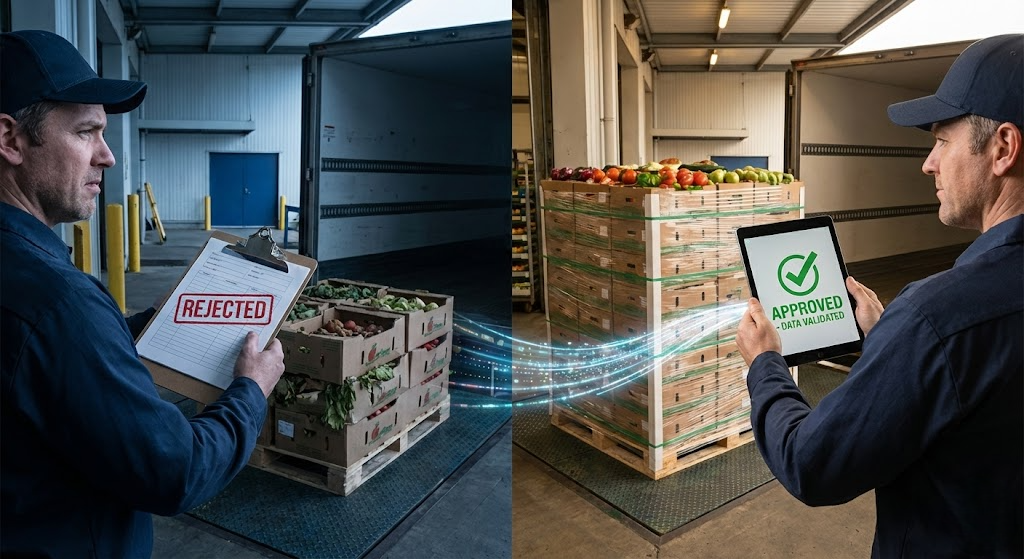
There is perhaps no phone call more dreaded in the food industry than the one from a major customer’s receiving dock.
"We’re rejecting the load."
In an instant, a shipment of valuable product transforms from revenue into a massive liability. The logistics scramble begins. Can it be salvaged? Can it be redirected to a secondary market at a steep discount? Or is it destined for the landfill, requiring you to pay freight both ways plus disposal fees?
For growers, processors, and food manufacturers, rejections are not just an annoyance; they are a significant bleed on profitability. In an industry operating on razor-thin margins, a single rejected truckload can wipe out the profit from ten successful ones.
Yet, many companies treat rejections as an unavoidable cost of doing business in a biological supply chain. They accept a certain percentage of failure as "normal."
At Loamy, we reject that premise.
In today’s data-driven world, the vast majority of food rejections are preventable. They are not acts of God; they are breakdowns in process, visibility, and communication.
Here is a deep dive into why shipments fail at the dock door and a practical roadmap for how to drastically reduce rejections in your operation.
The True Price Tag of a Rejection
Before fixing the problem, we must understand its full scope. Most operators only calculate the immediate financial sting: the cost of goods sold (COGS) and the wasted freight.
However, the "iceberg effect" of a rejection hides far greater costs below the surface:
- Operational Disruption: Your logistics team drops everything to manage the crisis. Your inventory planning is thrown into chaos. You suddenly need to scramble to fulfill the order with replacement product you may not have.
- Scorecard Damage: Major retailers and broadline distributors meticulously track supplier performance. A rejection is a black mark on your scorecard. Too many marks, and you risk losing shelf space, being de-prioritized for future contracts, or facing punitive fines.
- The Trust Deficit: This is the hardest to quantify but the most damaging. When a buyer rejects your load, they lose faith in your ability to deliver on spec. They will scrutinize your next ten shipments with a magnifying glass. You move from a trusted partner to a "problem supplier."
- Sustainability Impact: Food waste is a massive issue. Growing, processing, and transporting food only to dump it is an environmental tragedy that increasingly conflicts with corporate ESG goals.
Diagnosis: Why Shipments Fail
If you analyze rejection data across the industry, you find that very few rejections are truly surprising mysteries. They almost always fall into one of two categories: The Physical Failure or The Digital Failure.
This is the most obvious category. The product simply doesn't meet the agreed-upon specification upon arrival.
- Temperature Abuse: The cold chain was broken somewhere in transit. Berries arrived moldy, frozen goods arrived thawed, or leafy greens arrived wilted due to a reefer unit failure or improper pre-cooling before loading.
- Quality Fade: The product was technically "in spec" when it left your facility, but it didn't have enough shelf-life remaining to survive the journey. By the time it reached the customer, it was over-ripe, bruised, or decaying.
- Contamination or Pest Issues: Visible evidence of pests, foreign materials (plastic, wood), or adulteration detected upon inspection.
Surprisingly, a massive percentage of rejections have nothing to do with the food itself. The product is perfect, but the data accompanying it is flawed.
In the modern supply chain, if the data doesn't match, the product doesn't exist.
- Missing or Incorrect COAs: The Certificate of Analysis didn't arrive before the truck, or it shows results that are out of spec for a critical parameter (e.g., viscosity, pH, or pathogen testing).
- Mismatched Requirements: The product pulled for the order didn't match the requirements given by the customer.
- Labeling Errors: Barcodes that won't scan, pallets missing GS1-128 labels, or mislabeled allergens. If a retailer cannot scan it into their inventory instantly, they will not accept it.
The Proactive Shift: Moving Quality Upstream
The traditional approach to quality control is "inspect and reject" at the end of the line. You build a product, then you check it right before it goes on a truck.
If you want to stop rejections at your customer's dock, you must stop relying on final inspections at your dock.
By the time a product is finished and packaged, 95% of its quality fate is already sealed. You cannot inspect quality into a product at the end.
Reducing rejections requires moving from reactive inspection to proactive process control. It means shifting your focus upstream to your raw material suppliers and growers, ensuring that what enters your facility is perfect so that what leaves your facility is perfect.
Six Actionable Steps to Slash Rejection Rates
If your rejection rate is higher than 1%, you need a systemic overhaul. Here is a six-step roadmap for growers and manufacturers.
Are your product specifications locked away in a PDF on a Quality Manager's hard drive?
Specs are living documents. They need to be digital, accessible, and crystal clear to everyone in the chain—from the farm manager harvesting the crop to the forklift driver loading the truck.
If your supplier doesn't know exactly what "Grade A" means in terms of sizing, color, and defect tolerance, you cannot blame them for sending the wrong product. Digitize your specs and ensure suppliers have to acknowledge the current version before shipping.
This is the single most effective tactic for stopping rejections.
Do not allow a supplier to ship raw materials to you—and do not ship finished goods to your customer—until the data has been validated first.
Require suppliers to upload COAs, quality inspection results, and harvest data into a portal before the truck leaves their yard. If the data shows the product is out of spec, the system should flag it and prevent shipment.
Catching a bad load while it is still at the origin costs pennies compared to catching it at the destination.
Temperature fluctuations are a leading cause of fresh food rejections. Relying on the carrier’s word that the reefer unit was running is no longer enough.
Implement real-time IoT (Internet of Things) temperature monitoring devices in your shipments. This gives you visibility into the product's condition during transit. If a temperature excursion happens on Route 66, you know about it instantly. You can divert the load or alert the customer proactively, rather than surprising them with spoiled goods.
Your physical product must match your digital data perfectly.
Invest in automated labeling systems that integrate directly with your ERP. Ensure your ASN is sent automatically upon shipment and reflects the exact contents of the truck. Manual data entry for labels or ASNs is a reception waiting to happen.
Conduct regular audits of your own pallet labeling to ensure GS1 compliance. If your barcodes don't scan on the first try, fix your printers.
You are also a customer. Are you rejecting bad product from your suppliers?
If you accept subpar raw materials because you are desperate for inventory, you are practically guaranteeing you will ship subpar finished goods to your customers.
Standardize your own receiving inspections. Use a digital mobile app to guide receivers through a standardized check (temps, visual aids for specs, label checks). If it’s not right, reject it at your door so it doesn't get rejected at your customer's door.
Stop relying on "gut feelings" about which suppliers are performing well.
Track every incident. Which grower consistently has issues with mold? Which ingredient supplier always forgets the COA? Use data to create supplier scorecards. Share this data with them.
High-performing suppliers should be rewarded with more business; low performers need corrective action plans or need to be replaced.
How Loamy Stops Rejections Before They Happen
At Loamy, we built our platform specifically to bridge the information gap that leads to rejections.
We don't just store documents; we create an automated quality firewall around your operation.
By using Loamy for supplier management, you can require growers and suppliers to input critical quality data—harvest conditions, pesticide records, initial spec checks—into a shared portal.
Loamy can then help your team inspect product at receiving and shipping to remove inbound issues and reduce outbound rejections.
We help you ensure that the product and the data are perfectly aligned long before the truck bumps the dock at your customer's warehouse.
Conclusion: Visibility is Victory
Reducing food rejections isn't about hoping for better luck with the harvest or begging carriers to drive faster. It’s about aggressive, disciplined visibility.
In the high-stakes world of modern food supply chains, you cannot afford to be reactive. By digitizing your specifications, enforcing pre-shipment data validation, and holding your upstream supply chain accountable, you can turn the dreaded rejection call into a thing of the past.