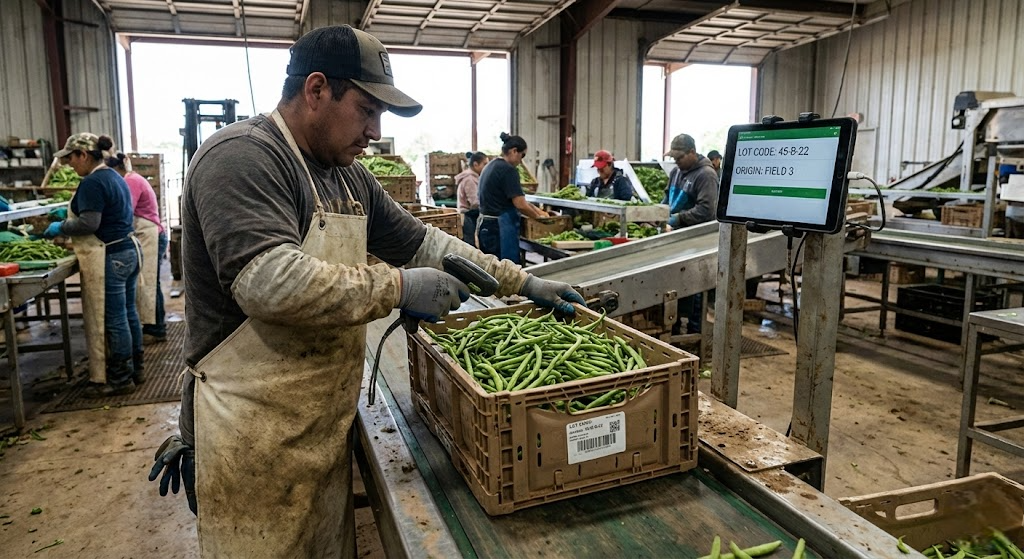
If you work in food production, "traceability" is likely a word you hear daily. But it is often framed as a burden—a regulatory tax, a paperwork headache, or a hurdle to jump over just to get your product on a retailer's shelf.
This perspective leads to competitors getting an edge over people who don't see the bigger picture.
For modern growers and food manufacturers, food traceability is not just about following rules; it is about quality and scalability. It is the operational backbone that separates fragile supply chains from resilient ones.
With the FSMA Rule 204 compliance deadline looming on the horizon, the industry is shifting from voluntary transparency to mandatory digital record-keeping. The "one step forward, one step back" model is dead.
At Loamy, we see this transition not as a hurdle, but as a massive opportunity to optimize your workflows. Let’s dismantle the jargon and look at what traceability actually means for your bottom line.
The Key Terms Defined: KDEs, CTEs, and TLCs
Forget the consumer-facing marketing fluff about "farm stories." For a manufacturer or grower, traceability is a data discipline. It is the systematic capture of information at specific points in your operation to create a digital thread that can withstand an FDA audit.
To understand this, we must speak the language of the Food Safety Modernization Act (FSMA). There are three acronyms every operations manager needs to know:
- Critical Tracking Events (CTEs): These are the specific moments in your supply chain where data must be captured. They include harvesting, cooling, initial packing, shipping, receiving, and transformation (processing).
- Key Data Elements (KDEs): This is the specific data you must record for each CTE. It’s not enough to say "received 500 lbs of tomatoes." You need the location description, the date, the quantity, the unit of measure, and the reference document type.
- Traceability Lot Code (TLC): This is the unique alphanumeric descriptor assigned to a specific lot of food. This code must remain linked to the food as it moves through the supply chain, even as it changes hands.
True traceability for a business means you can produce an "electronic sortable spreadsheet" containing all relevant KDEs for a specific TLC within 24 hours of an FDA request.
If your current system involves chasing down emails or digging through filing cabinets, you are not traceable. You are vulnerable.
The Regulatory Cliff: FSMA Rule 204
The most pressing driver for traceability right now is the FDA’s "Food Traceability Rule" (FSMA 204). This rule applies to the Food Traceability List (FTL), which covers high-risk foods like leafy greens, melons, peppers, fresh herbs, soft cheeses, and seafood.
Here is the reality check for growers and processors:
- The Deadline is Real: The FDA has already talked about their commitment to the regulation and how they want to go even further in the future.
- It Covers the Whole Chain: It doesn't matter if you are a small farm or a massive processor; if you touch FTL foods, you likely have record-keeping obligations.
- No More Paper: The rule essentially mandates digital record-keeping. The requirement to provide an electronic sortable spreadsheet means manual paper logs are now a liability.
However, waiting for the FDA to knock on your door is a bad strategy. The real pressure is coming from your customers.
The Retailer Mandate: Market Access
Before the FDA ever audits you, your biggest buyers will. Major retailers (like Walmart, Kroger, and Costco) and huge foodservice distributors are not waiting for 2026. They are implementing their own stringent traceability requirements now. They are demanding:
- ASN (Advance Ship Notices) with full lot details.
- GS1-128 labeling compliance.
- Mock recall drills passed with 100% accuracy in under 2 hours.
For a manufacturer, traceability is your ticket to market access. If you cannot provide granular data on where your ingredients came from and where your finished goods went, you will be de-listed. Traceability is no longer a "nice-to-have" feature for premium brands; it is the minimum entry fee for doing business with major players.
Operational Efficiency: The Hidden ROI
Once you stop viewing traceability as a compliance cost, you can start using it as an operational weapon. Implementing a robust system like Loamy to manage your supplier data and workflows unlocks significant ROI in three key areas:
When you track KDEs accurately, you know exactly what you have, where it is, and how old it is.
- Reduce Spoilage: unexpected First-In, First-Out (FIFO) becomes easy when lot codes are digital. You can identify aging inventory before it becomes waste.
- Yield Analysis: By tracing finished goods back to specific raw material lots, you can analyze which suppliers provide the highest yield. You might find that "Cheaper Supplier A" actually costs you more in waste than "Premium Supplier B."
Without traceability, a contamination scare is a nuclear event. If you can't prove exactly which batch of onions is contaminated, you have to recall everything.
- The Cost Difference: A blanket recall can cost millions and bankrupt a company. A surgical recall, where you isolate only the specific affected lot codes, might cost a fraction of that.
- Brand Protection: Being able to tell a retailer, "Only lots A, B, and C are affected; lots D through Z are safe," preserves your reputation and your shelf space.
Food manufacturers often struggle with the "black box" of their upstream supply chain. Traceability forces transparency.
- You can instantly flag suppliers who fail to provide required KDEs or Certificates of Analysis (COAs).
- You can automate the rejection of shipments that don't meet data requirements, stopping problems at the dock door before they enter your facility.
The Tech Stack: Moving Beyond Spreadsheets
Many food businesses are still trying to manage this complexity with Excel and email. This is a recipe for disaster. Spreadsheets are static, prone to human error, and disconnected from the physical reality of the factory floor.
To handle modern traceability, you need a Golden Thread of data that connects:
- ERP (Enterprise Resource Planning): Financials and inventory.
- QMS (Quality Management System): Safety checks and compliance.
- Supplier Management (Loamy): The collaborative layer where the actual data exchange happens.
How Loamy Solves the Data Gap
The hardest part of traceability isn't tracking what happens inside your four walls—it's getting accurate data from the people outside your walls (your suppliers) and passing it to the people downstream (your customers).
This is where Loamy fits in. We don't just store documents; we automate the workflow of traceability and bring everything together in a single platform.
- Automated Data Capture: Instead of manually typing in lot codes from a PDF email attachment, Loamy can generate it automatically and track every repack or processing event.
- Supplier Portals: Give your growers a direct way to collaborate, plug in field estimates, and even generate PTI labels from the field.
- Audit-Ready Reporting: When the FDA or a retailer asks for that "electronic sortable spreadsheet," Loamy can generate it in clicks, not days.
Conclusion: Future-Proofing Your Operation
The era of anonymity in the food supply chain is over.
For growers and manufacturers, the question is no longer "What is food traceability?" The question is "How quickly can we automate it?"
Those who drag their feet will find themselves buried in paperwork and locked out of major retail contracts. Those who embrace it will build operations that are leaner, safer, and ready for scale.
Don't let compliance be your ceiling. Make it your floor.
Key Takeaways:
- Traceability is Data: It requires capturing Critical Tracking Events (CTEs) and Key Data Elements (KDEs).
- The Clock is Ticking: FSMA Rule 204 compliance is due by January 20, 2026.
- Recall Readiness: Effective traceability allows for surgical recalls, saving millions in lost product.
- Loamy Advantage: Automation is the only way to manage supplier data at scale without drowning in administrative work.